

Coming from TradFi
Moment is a strip market for on-chain yield: it cuts a yield-bearing asset into dated periods and lets you trade each at its own forward rate, paid up front.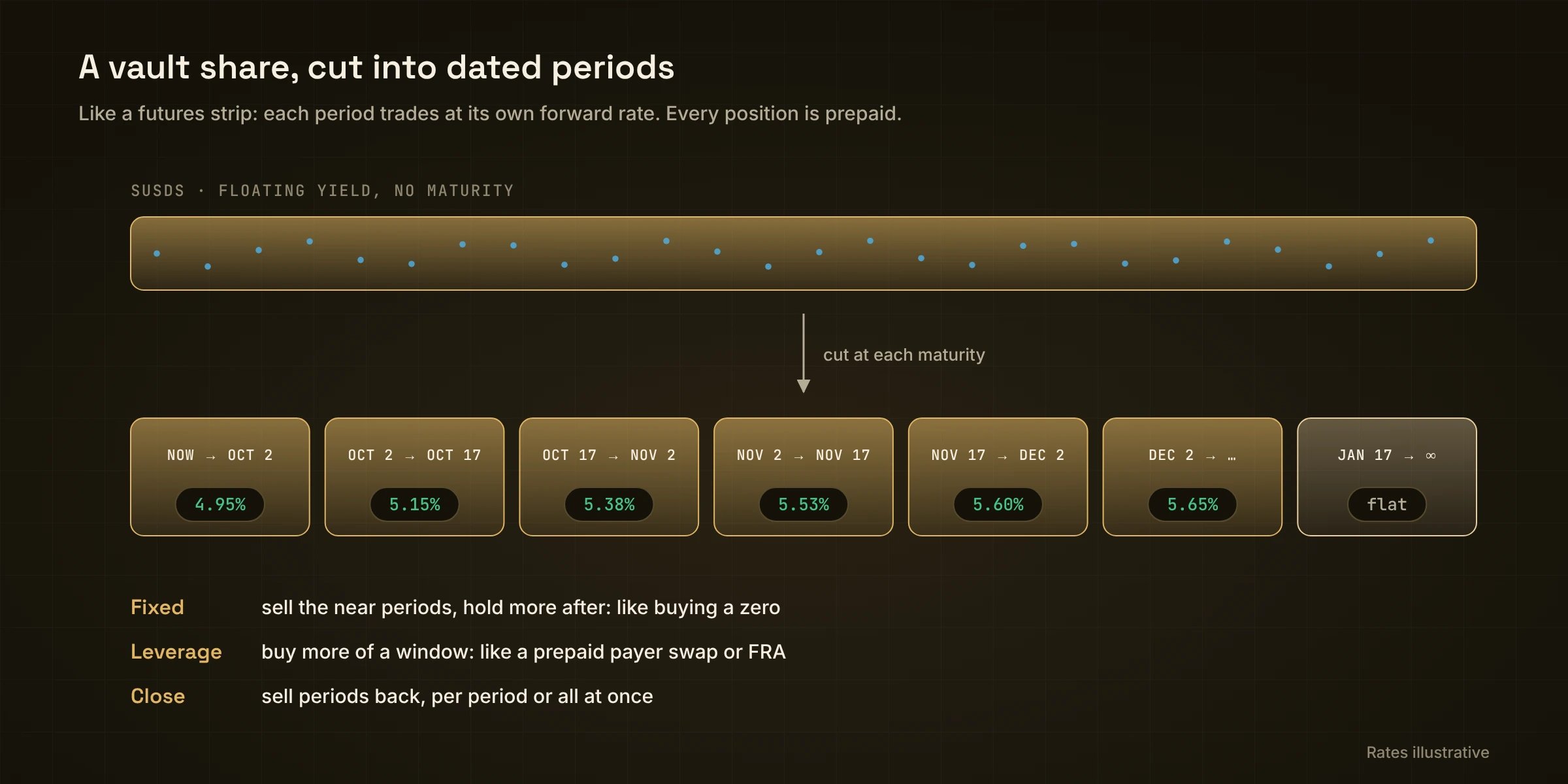
A floating asset with no maturity, cut into dated periods like a futures strip.
The short version
Think of a yield-bearing vault share as a floating-rate note with no maturity. Moment lets you strip its yield into dated periods, like STRIPS. Each period trades at its own forward rate, like a contract month in a SOFR futures strip. Every position is prepaid: no margin, no funding and no liquidation. Leverage still has a notional, and that is the point: it is the exposure you are targeting, paid for up front, so you can never lose more than you paid.Translation table
What’s different
- Prepaid, not margined. “Leverage” means more yield exposure per unit of capital, like owning a coupon strip. The notional is the exposure you chose, fully paid up front: no variation margin, no liquidations and no margin-funded size.
- No benchmark fixing. The floating leg is the vault’s realised yield, not SOFR. Underlying vault risk is your risk.
- Continuous time. Interest accrues by the second on-chain, on an ACT/365 basis. There are no business-day rules and no payment lag.
- Forward periods, not spot tenors. A Moment period is a disjoint window, like one futures contract month, not a 2Y or 5Y point.
- LPs carry their fills. A dealer hedges its bucketed DV01. A Moment liquidity provider keeps what fills, like a ladder of resting orders.
- Settlement is a balance change. Proceeds land in your TimeBalance at the next sync, not as an FRA-style discounted cash payment.
- Fees are charged on premium. The taker fee applies to the interest value traded, not to notional. See Fees.
Strategies you can run
Coming from DeFi
If you’ve fixed yield with a PT or gone long yield with a YT, you know Moment’s trades; but Moment never splits your asset into dated tokens.One balance, not a split
In PT/YT split designs, each maturity gets its own pair of tokens and its own pool. On Moment you hold one balance laid out across time, your TimeBalance, and every trade reshapes it.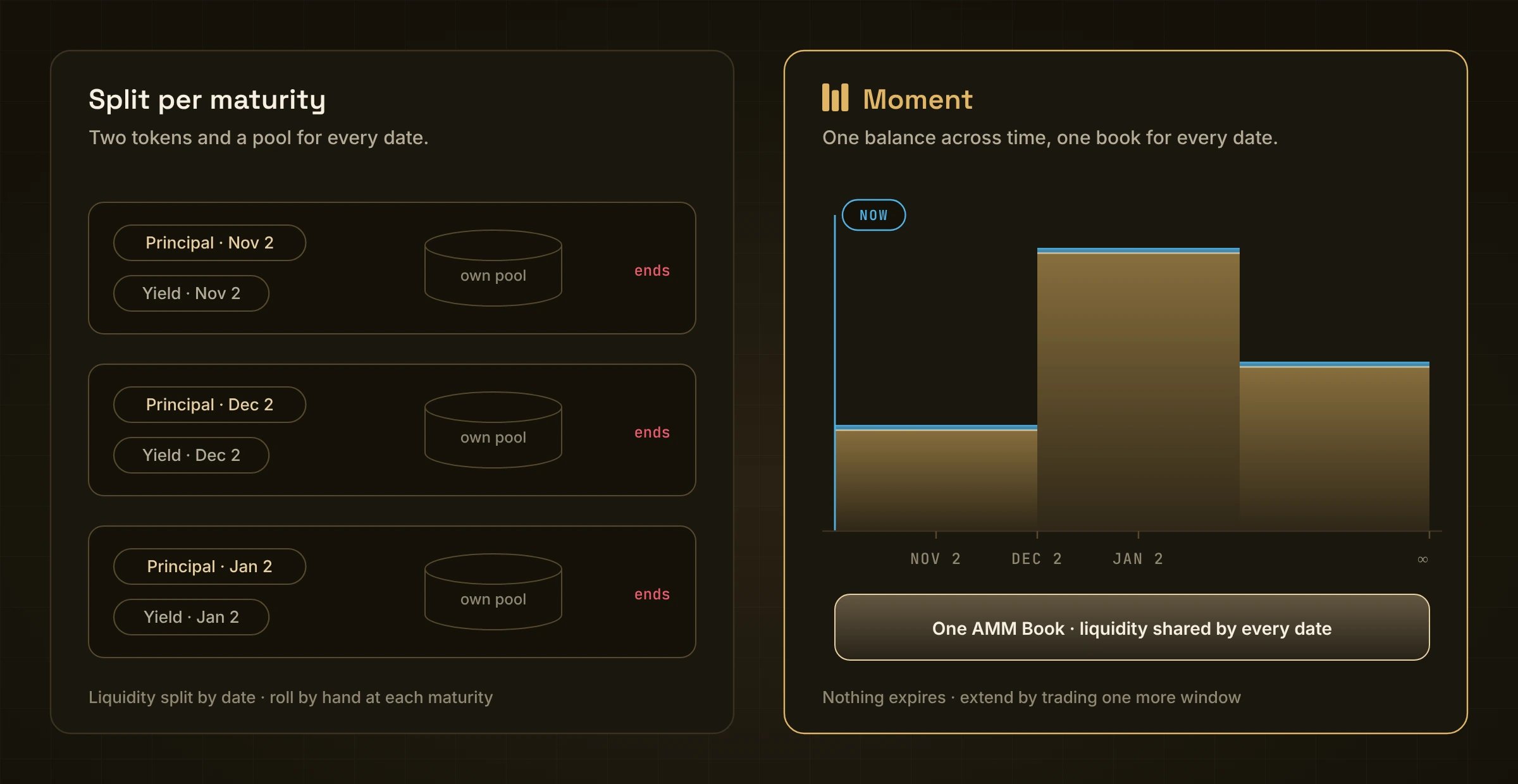
Left: a token pair per maturity. Right: one continuous TimeBalance.
Translation table
What’s different
- One position per asset, not one per maturity. You never manage a drawer of dated tokens.
- Windows, not “now to maturity”. Forward exposure is native. You can lever a window that starts in two weeks, rather than implying it from two maturities.
- No maturity cliff. When a maturity passes, your balance just continues and keeps earning.
- Liquidity is shared. A trade to a far maturity routes through every earlier period, so early liquidity serves every later trade.
- Orders, not just curves. Liquidity providers place limit orders at a rate, or quote a bid and an ask around the market.
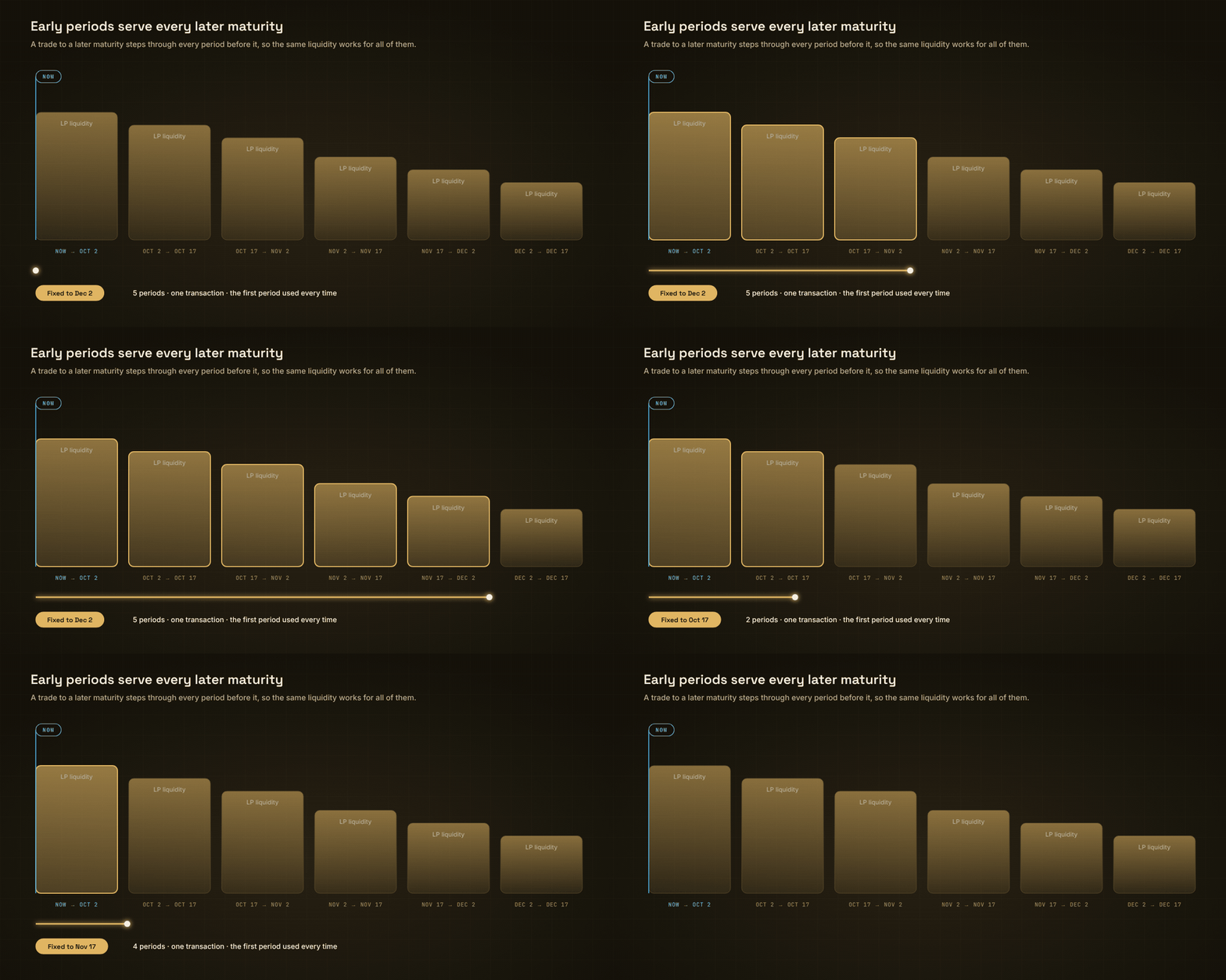
A trade to a far maturity steps through every earlier period in the same book.
Strategies
Leverage is prepaid. If the vault’s realised yield over your window averages below the rate you paid, you lose part of what you paid, and at 0% yield you lose all of it. Nothing can force-close your position.