

The problem
Yield-bearing assets pay whatever they pay, for as long as you hold them. Holders can’t lock a known result by a date, or concentrate exposure into a window they believe in. Their only lever is to hold or sell. Existing yield-trading designs split each asset into separate tokens per maturity, each with its own pool. Liquidity is fragmented across maturities, positions expire, and users have to roll.Why time-sliced yield
Moment treats a position as one TimeBalance: the balance laid out from Now to ∞. Every trade reshapes it. Built on the TBT (TimeBound Token) standard, the TimeBalance adds time to what ERC-4626 already tracks: quantity and yield. That gives users three things split designs struggle with:- One position per asset. Nothing expires and nothing needs rolling.
- Any window. Exposure can start later than today, not only “now to maturity”.
- Prepaid leverage. No margin, no funding and no liquidations.
How liquidity is shared
Time is cut into periods between maturities, and all maturities sit in one AMM Book. A trade to a far maturity steps through every earlier period in order. So liquidity in an early period serves every trade that reaches past it.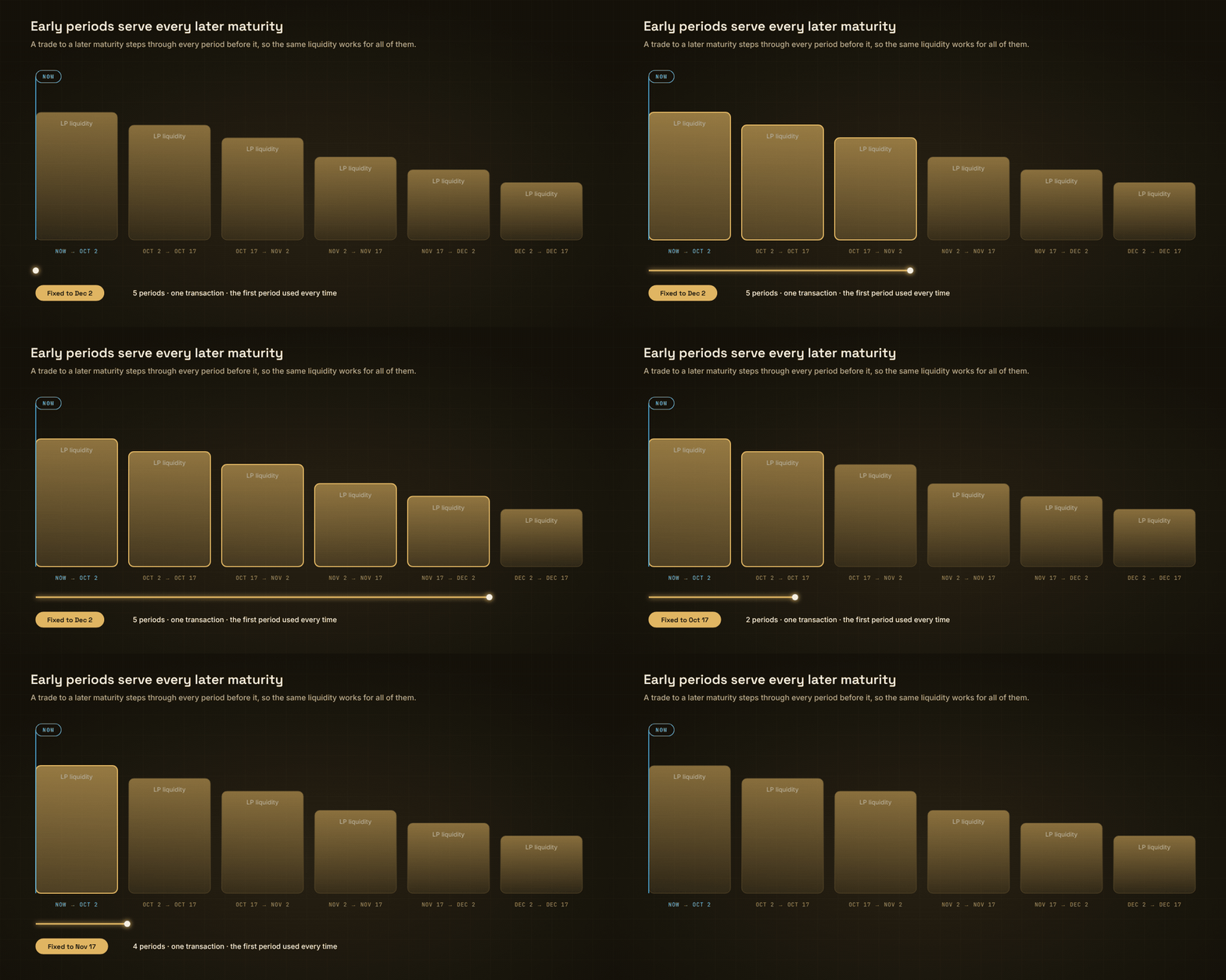
One book: early periods serve every later trade.
Revenue
The taker fee is charged on premium, the interest value traded, not on notional. A Fixed taker receives the maker’s rate scaled down by 0.5%; a Leverage taker pays it scaled up by about 0.5%. Makers pay no fee on their fills. Wrapping and unwrapping carry no Moment fee. All protocol fees go to the protocol owner. See Fees.
Headline metrics
Raw TBT units mislead. A short window of 2,500 TBT can be worth only a few dollars, so the metrics always use present value.
TVL in LP need not be high. Because liquidity is shared across maturities, a small amount of LP liquidity can serve large Fixed trades.
Design target, not a measured result: at a 6% rate, about 10K USDS of LP liquidity can serve a two-month, 1M USDS Fixed trade. See the worked example in How it works.
Status
There are no live metrics dashboards yet. For what can go wrong, see Risks and security.This page describes how the protocol is designed. It is not investment advice or an offer of any asset.